

Choosing a new heating system for your Ontario home is a major decision. It’s not just about staying warm through a January cold snap; it’s about long-term costs, energy efficiency, and making a choice you’ll be confident in for the next 15 to 20 years.
You’re likely hearing more and more about air source heat pumps as an alternative to the traditional gas furnace. But with our uniquely cold winters, it’s fair to ask: are they a practical choice, or just hype?
This guide is designed to give you a clear, data-driven comparison. We’ll cut through the noise and focus on what truly matters for homeowners in Orangeville and across Ontario, from actual performance in -20°C weather to the real-world costs you can expect.
The Core Difference: Creating Heat vs. Moving Heat
To understand the comparison, we first need to look at how each system fundamentally works. It’s a simple but critical distinction.
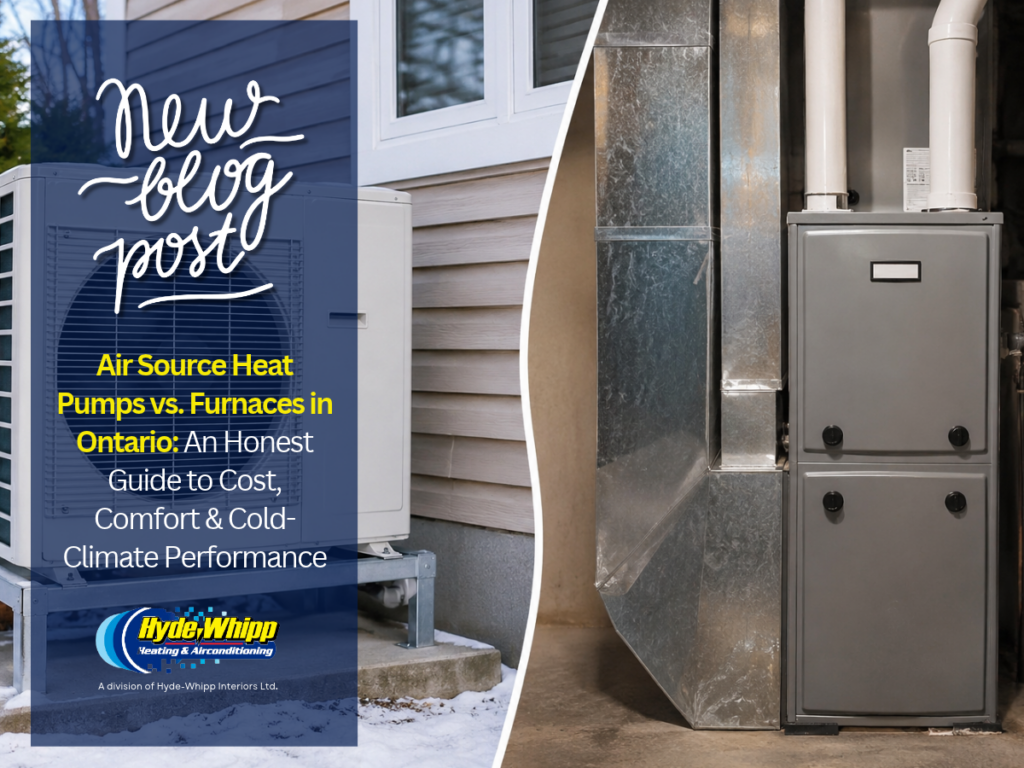
- A Traditional Furnace creates heat. It burns a fuel, typically natural gas, to generate heat, which is then distributed through your home’s ductwork. Its efficiency is measured by its Annual Fuel Utilization Efficiency (AFUE). A 96% AFUE furnace converts 96% of its fuel to usable heat, with 4% lost through exhaust.
- An Air Source Heat Pump moves heat. Even when it’s cold outside, there is still ambient heat energy in the air. A heat pump extracts this energy from the outdoor air and transfers it inside to warm your home. In the summer, it reverses the process to provide cooling. Its efficiency is incredibly high, often reaching 250% to 400%, because it uses electricity to move existing heat rather than create it from scratch.
This fundamental difference is why a high-efficiency gas furnace tops out at around 98% efficiency, while a modern heat pump can deliver 2.5 to 4 units of heat for every single unit of electricity it consumes.
The Ontario Winter Test: Can Heat Pumps Handle a Canadian Freeze?
This is the most important question for any Ontario homeowner. The short answer is yes, but only if you choose the right technology.
Early-generation heat pumps struggled in deep cold, rightfully earning a reputation for being unsuitable for our climate. However, modern cold-climate air source heat pumps (CC-ASHPs) are engineered specifically for this challenge, operating effectively down to -25°C and even -30°C.
So, what should you look for? When evaluating a heat pump for our region, ignore the marketing slogans and focus on two key performance metrics:
- Heating Capacity at -15°C: This tells you how much heating power the unit retains in serious cold. Look for a model that maintains at least 70% of its full heating capacity at -15°C.
- Coefficient of Performance (COP) at -15°C: This is its real-world efficiency rating in the cold. A good target for a quality cold-climate model is a COP of 1.75 or higher at -15°C, meaning it’s still 175% efficient.
Modern systems achieve this with advanced variable-speed compressors and refrigerants that work effectively at low temperatures. They also have a “defrost cycle” that briefly runs to melt any ice buildup on the outdoor unit, ensuring it can continue to absorb heat from the air.
A Deep Dive into the Costs for Ontario Homeowners
Let’s break down the financial side of the equation, looking at upfront costs, long-term operating expenses, and the impact of rebates.
Upfront Installation Costs
There’s no hiding it: a full cold-climate air source heat pump system typically has a higher upfront installation cost than a replacement gas furnace. You are essentially buying both a high-efficiency heating system and a central air conditioner in one unit.
| System Type | Typical Installed Cost Range (Ontario) | Key Considerations |
|---|---|---|
| High-Efficiency Gas Furnace | $5,000 – $8,500 | Assumes existing ductwork and gas line are adequate. |
| Central Cold-Climate ASHP | $12,000 – $20,000+ | Includes indoor and outdoor units. Cost varies with size, brand, and potential electrical upgrades. |
| Hybrid (Dual-Fuel) System | $14,000 – $22,000+ | Combines a new heat pump with a new gas furnace. Highest upfront cost but offers ultimate flexibility. |
These are estimates, and the final price depends on your home’s specific needs. But it’s clear that government incentives play a crucial role in making the switch more accessible.
Long-Term Operating Costs
This is where the conversation gets interesting. Because natural gas is relatively inexpensive in Ontario, the operating cost savings with a heat pump aren’t as dramatic as in other regions.
According to Natural Resources Canada, the annual operating costs for a cold-climate heat pump are often comparable to a conventional gas furnace in our province. Your electricity plan (Time-of-Use vs. Tiered) and the severity of the winter will influence your exact bills. For homeowners looking for the most effective way to lower utility bills, exploring all available energy-efficient heating solutions is a crucial first step.
The primary long-term financial benefit comes from combining two purchases into one, heating and cooling, and future-proofing your home against potential carbon tax increases and volatile natural gas prices.
Unlocking Savings: A Clear Guide to Ontario Heat Pump Rebates
Government rebates are designed to bridge the gap in upfront costs. The programs change, but as of late 2026, Ontario homeowners can take advantage of significant incentives:
- Home Renovation Savings (HRS) Program: This provincial program provides substantial rebates for installing eligible cold-climate ASHPs. For homes without natural gas (e.g., heated by oil or electricity), rebates can be up to $7,500. For homes with existing gas heating, rebates can be up to $2,000.
- Income-Qualified Programs: For households meeting certain income thresholds, there are often programs that provide no-cost heat pump installations, making energy-efficient technology accessible to everyone.
Navigating these programs can be complex, but they can dramatically change the financial viability of a heat pump installation.
The Hybrid “Dual-Fuel” System: The Smart Choice for Many Ontarians?
For many homeowners in our region, the ideal solution isn’t an “either/or” choice. It’s a hybrid, or “dual-fuel,” system.
This setup combines a new cold-climate air source heat pump with a high-efficiency gas furnace. Here’s how it works:
- Above ~0°C: The ultra-efficient heat pump handles all your heating and cooling needs.
- Below ~0°C (the “balance point”): The system automatically switches to the gas furnace for powerful, cost-effective heating during the coldest days of the year.
This approach gives you the best of both worlds: incredible energy efficiency for most of the year and the unwavering power of a gas furnace for the deep freeze, ensuring absolute peace of mind.
Beyond the Box: Why Your Whole Home’s Performance Matters
A heat pump’s performance isn’t just about the equipment itself, it’s about how it works within your home as a complete system. This is a critical point that is often overlooked.
To get the most out of a heat pump, your home needs to be ready for it. Factors like insulation, air sealing, and windows have a massive impact on its efficiency. A well-insulated and air-sealed home holds onto the heat the system produces, allowing it to run less often and save you more money.
Before any installation, a thorough assessment should be done to see if your ductwork is sized properly and if your home’s electrical panel can handle the load. Investing in insulation or air sealing alongside your new HVAC system can multiply your energy savings.
The Installation is Everything: Questions to Ask Your HVAC Contractor
The single biggest factor in the performance and lifespan of your new heating system is the quality of the installation. A top-of-the-line heat pump will underperform if it’s not installed correctly.
A true professional will go beyond just swapping out boxes. Before you sign a contract, make sure your contractor is discussing:
- A Manual J Heat-Loss Calculation: A detailed analysis to determine the exact heating and cooling load of your home. Sizing matters more than the brand name on the unit.
- Ductwork Evaluation: Checking if your existing ducts can handle the specific airflow requirements of a heat pump, which can differ from a furnace.
- Outdoor Unit Placement: Planning for proper drainage of the defrost cycle and ensuring the unit is elevated to stay clear of snow drifts.
- Commissioning the System: After installation, a technician should perform a full commissioning process to test refrigerant levels, check airflow, and configure the controls to match your home perfectly.
A commitment to professional HVAC installation is what separates a system that merely works from one that performs optimally for decades.
Making the Right Call: A Decision Guide for Your Home
So, which system is right for you? Here’s a simple framework to help you decide.
Choose a High-Efficiency Gas Furnace if…
- You are on a tighter budget for upfront costs.
- Your existing central air conditioner is relatively new and in great shape.
- You have an extremely well-insulated home in an area with very low natural gas rates.
Choose a Full Air Source Heat Pump System if…
- You need to replace both your furnace and air conditioner at the same time.
- Your home is not serviced by natural gas (e.g., you use oil, propane, or electric baseboard).
- Your top priority is reducing your carbon footprint and moving away from fossil fuels.
Choose a Hybrid Dual-Fuel System if…
- You want maximum efficiency for most of the year combined with total peace of mind in the coldest weather.
- You’re looking for the most flexible, future-proof solution for Ontario’s climate and energy market.
- You have an aging furnace but want to integrate the latest energy-saving technology.
Frequently Asked Questions
How long do heat pumps and furnaces last?
A well-maintained gas furnace typically lasts 15-20 years. A heat pump’s lifespan is similar, around 15 years. Because it runs year-round for both heating and cooling, consistent annual maintenance is key to its longevity.
Will a heat pump increase my home’s value?
As energy efficiency becomes more important to homebuyers, homes equipped with modern, high-efficiency systems like heat pumps are increasingly attractive. It signals a modern, future-ready home with lower anticipated energy costs.
Is my home’s electrical system ready for a heat pump?
This is a critical question. Some older homes with 100-amp service may require an electrical panel upgrade to a 200-amp service to safely handle the electrical load of a central heat pump, especially if you also have other large electric appliances. This should be a key part of any professional assessment.
What maintenance does a heat pump need compared to a furnace?
Maintenance is similar but crucial for both. Both systems require regular filter changes. For a heat pump, it’s also important to keep the outdoor coil clean and free of debris. Both systems benefit immensely from an annual professional tune-up to ensure they are running safely and at peak efficiency.
Your Next Step to Year-Round Comfort
Choosing between a furnace and a heat pump is a complex decision with many factors to consider. The right answer depends entirely on your home, your budget, and your long-term goals.
For over 40 years, our family at Hyde-Whipp has been helping homeowners in Orangeville and the surrounding communities find the perfect home comfort solutions. We believe in providing honest advice and technically excellent installations that stand the test of time.
If you’re ready to explore the best options for your home, the next step is a detailed, no-pressure evaluation. Let’s look at your current system, understand your needs, and provide you with a clear, comprehensive quote.
Schedule a personalized home comfort assessment with our team today and make your next big home decision with confidence.