

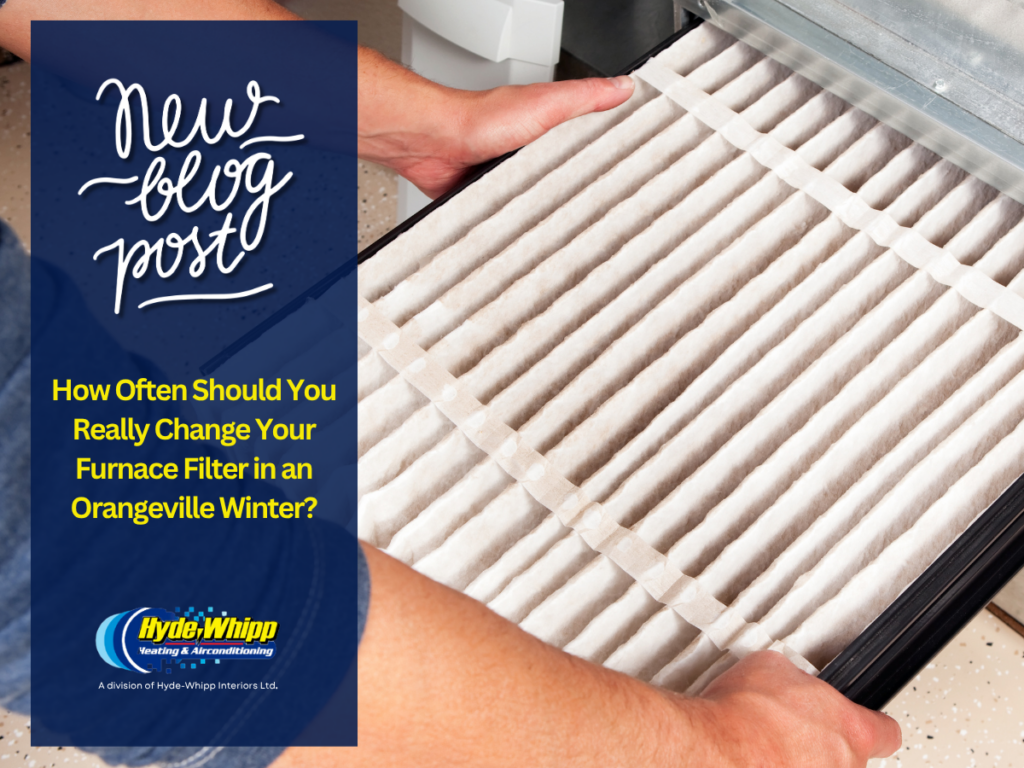
Most furnace filters need changing every 4 to 6 weeks during an Orangeville winter, not the every-3-months interval often quoted for milder climates. A Dufferin County furnace runs close to continuously from November through March, which pushes far more air, and far more dust, pet dander, and dry-air particles, through the filter than the same system sees in spring or fall. This guide covers the real winter interval, how filter type changes the timing, and the signs your filter is already overdue.
Why Winter Is Different From the Generic 3-Month Rule
The standard advice to change a furnace filter every 90 days assumes a furnace that cycles on and off moderately throughout the year. That assumption does not hold in a Dufferin County winter. Once temperatures drop and stay down, a furnace runs far more often, sometimes nearly continuously overnight, which means a 1-inch filter rated for three months of average use can hit that same load in closer to four to six weeks. Homes with pets, forced-air ventilation running constantly to manage dry winter air, or recent renovation dust will land at the shorter end of that range.
TL;DR
- Standard 1-inch filters need changing every 4 to 6 weeks in winter, not the 3-month interval that applies to lighter-use seasons.
- Thicker filters last longer. A 4 to 5 inch media filter can often go 6 to 12 months, even through a full heating season.
- Furnace runtime is the real driver, not the calendar. A furnace running nearly continuously in a cold snap pushes far more air through the filter than the same unit does in October.
- A dirty filter costs more than a new one. Restricted airflow makes the furnace work harder, raises energy bills, and can shorten the life of the blower motor.
- Check monthly, replace when needed. Checking every four weeks and changing based on what you see is more reliable than following a fixed date.
How Often to Change Different Filter Types in Winter
Filter thickness has the single biggest effect on how long it lasts, and most competing advice does not separate these clearly enough for a real Ontario heating season.
Filter Type | Typical Mild-Climate Interval | Realistic Orangeville Winter Interval |
1-inch standard filter | Every 90 days | Every 4 to 6 weeks |
2-inch filter | Every 3 to 4 months | Every 6 to 8 weeks |
4 to 5 inch media filter | Every 6 to 12 months | Every 4 to 6 months |
High-MERV (11+) filter | Monthly to every 60 days | Every 3 to 4 weeks |
Quick answer: The higher the MERV rating and the thinner the filter, the more often it needs to be replaced, and a full Ontario heating season shortens every one of these intervals compared to a milder or shorter winter.
Why Furnace Runtime Matters More Than the Season Change
A furnace that runs 15 minutes an hour in October and 45 minutes an hour in January is moving roughly three times as much air through the same filter. That difference is the actual reason winter filters clog faster, not the season itself. A furnace running close to continuously during a deep cold snap can push a standard filter past its rated capacity well before the three-month mark most manufacturers print on the box.
Signs Your Furnace Filter Is Already Overdue
- Airflow feels weaker at the vents than it did last month. A clogged filter restricts how much air the blower can push through the ductwork.
- The furnace runs longer to reach the same thermostat setting. Reduced airflow makes the system work harder to heat the same space.
- Heating bills are climbing without any change in the thermostat schedule. A restricted filter is one of the most common, and most overlooked, causes of rising winter energy costs.
- Visible dust buildup around vents or on the filter itself. If you can see grey buildup across the filter surface when you check it, it is already past due.
- A musty or stale smell when the furnace kicks on. This often points to dust and particles accumulating faster than the filter can trap them.
What Happens If You Skip Filter Changes All Winter
A furnace does not stop working with a clogged filter, but it starts working harder for the same result. Restricted airflow forces the blower motor to run longer and pull more power to move the same amount of heated air, which shows up directly on the energy bill. Left long enough, that extra strain can shorten the life of the blower motor and, in some systems, contribute to the furnace overheating and shutting itself off mid-cycle. Regular filter checks are one of the simplest ways to protect the investment in your furnace through the months it works hardest.
Frequently Asked Questions
How often should I change my furnace filter in winter?
A standard 1-inch filter should be changed every 4 to 6 weeks during a full Ontario winter, since the furnace runs far more often than it does in spring or fall. Thicker media filters, 4 to 5 inches, can often go 4 to 6 months even through the coldest stretch.
Does a dirty furnace filter increase heating bills?
Yes. A clogged filter restricts airflow, which forces the blower motor to work harder and run longer to heat the same space. That extra runtime shows up as a higher energy bill even when the thermostat schedule has not changed.
What MERV rating should I use for my furnace filter?
A MERV rating between 8 and 11 works well for most homes, balancing filtration with airflow. Filters rated MERV 11 or higher trap more particles but need more frequent changes, often every 3 to 4 weeks, since they restrict airflow more as they load up with dust.
Can a dirty filter damage my furnace?
Yes. A severely clogged filter restricts airflow enough that the blower motor has to work harder, which can shorten its lifespan over time. In some systems, badly restricted airflow can cause the furnace to overheat and shut down mid-cycle as a safety response.
Should I check my furnace filter every month in winter?
Yes. Checking monthly and replacing based on visible dust buildup or reduced airflow is more reliable than following a fixed replacement date, since furnace runtime, not the calendar, is what actually determines how fast a filter loads up.
Action Steps
- Check your filter every four weeks through the heating season. Hold it up to a light source, if you cannot see light through it clearly, it needs to be replaced.
- Match your replacement schedule to your filter’s thickness. A 1-inch filter needs far more frequent changes than a 4 to 5 inch media filter.
- Watch for weaker airflow or rising heating bills. Both are early signs of a filter that is already restricting your system.
- Keep a few filters on hand before winter starts. Running out mid-cold-snap is an easy problem to avoid with one extra trip in the fall.
- Add filter checks to your annual tune-up.
A Hyde-Whipp protection plan includes a full system inspection that catches airflow issues a homeowner might miss.
A furnace filter that would last three months in a mild season often needs replacing every 4 to 6 weeks during a real Dufferin County winter, because it is furnace runtime, not the calendar, that determines how fast it loads up.
Not Sure What Filter Your System Needs?
Contact Hyde-Whipp Heating & Air Conditioning for guidance on the right filter type and replacement schedule for your specific furnace. We can also check your filter and airflow as part of a full system inspection before the coldest part of the season arrives.